

Finding the right functional medicine practitioner starts with choosing a licensed clinician who can safely guide you through root-cause testing, individualized care plans, and realistic lifestyle changes. The goal isn’t just to quiet symptoms for a while, but to understand what’s driving your chronic concerns and address those patterns over time. Whether you are in Bergen County or the surrounding areas, a Functional Medicine Doctor Bergen County at Advanced Integrated Health can help you build a personalized, root-cause care plan tailored to your unique needs.
When you know how to check credentials, evaluate their approach, and see whether their style fits your needs, it becomes much easier to feel safe and supported in care. Keep reading to learn clear, practical steps for choosing a practitioner you can trust.
Key Takeaways
- We should verify credentials, licensure, and IFM certification before starting care.
- We need alignment on treatment philosophy, communication, and patient-centered care.
- We can use trusted directories and telehealth to expand access when local options are limited.
What is a functional medicine practitioner, and how do they differ from conventional doctors?
A functional medicine practitioner is a licensed clinician who focuses on why your symptoms started and how your body systems connect, instead of only asking, “What diagnosis fits this?” They use a systems biology approach, looking at gut health, hormones, immunity, metabolism, and the nervous system as one network rather than separate parts.
Compared with a typical short conventional visit, functional medicine care usually includes:
- A long intake that maps your health timeline, diet, stress, sleep, infections, and exposures
- Use of targeted labs (like stool tests, organic acids, or DUTCH hormone testing) when appropriate
- Personalized health plans instead of one-size-fits-all protocols
- Ongoing tracking with both symptoms and biomarkers
Most functional medicine doctors are MDs, DOs, NDs, or NPs, and many complete advanced training through the Institute for Functional Medicine (IFM). Conventional care often centers on diagnosis and medication. Functional medicine still uses those tools when needed, but adds nutrition therapy, lifestyle medicine, and behavior change rooted in functional medicine care principles to address root causes.
People often seek this care for IBS, autoimmune conditions, thyroid problems, fatigue, metabolic syndrome, hormone imbalance, or post-viral issues, especially when standard care feels incomplete. For patients in southern New Jersey, a complex illness consultation provides this same systems-based approach to chronic health concerns.
How can we find qualified functional medicine practitioners near us or online?

Finding a qualified functional medicine practitioner starts with using trusted directories, not just general search engines or social media. Structured search tools are safer because they screen for training, licensure, and real functional medicine education before listing someone, which lowers the risk of ending up with an unqualified provider.
Two reliable options include:
- IFM Practitioner Finder
- Verifies Institute for Functional Medicine (IFM) training and certification
- Let’s you filter by license, location, and practice details
- Covers 3,100+ practitioners across 74 countries, including telehealth
- SearchFunctionalMedicine.com
- Filters by city, specialty, language, and virtual care
- Lists global practitioners, both local and fully online
For people in Batam and nearby areas, local functional medicine choices may be limited. In that case, telehealth with doctors based in Singapore or Jakarta is often a realistic path. Many of them can:
- Coordinate functional lab panels remotely
- Provide follow-up visits online
- Integrate health coaching and lifestyle guidance by video
This mix of vetted directories and telehealth means you can focus on quality and fit, rather than just who happens to be closest to you, which is especially important when seeking functional medicine services tailored to individual needs.
| Directory | Filters Available | Coverage |
|---|---|---|
| IFM Practitioner Finder | Certification, license, location | Global |
| SearchFunctionalMedicine.com | City, language, virtual care | Global |
What credentials should a functional medicine practitioner have?

The core credential for any functional medicine practitioner is a valid clinical license. That license shows they’re legally allowed to diagnose, treat, and order labs, which is central for safety and accountability.
You’ll usually want to look for:
- Active medical license
- MD (Medical Doctor)
- DO (Doctor of Osteopathic Medicine)
- NP (Nurse Practitioner)
- ND (Naturopathic Doctor, in licensed regions)
- Verified through state or national board websites
- Functional medicine training
- Courses or certification through the Institute for Functional Medicine (IFM)
- IFM Certified Practitioner (IFMCP) is a strong signal of standardized education and ethics
- Experience with your condition
- For gut issues: SIBO, microbiome, IBS
- For hormones: thyroid, PCOS, perimenopause, low testosterone
- For autoimmune: protocols for immune regulation and inflammation
Quality care also shows up in how they practice. They should explain why they pick certain labs or supplements, how long a plan may take, and what outcomes they’re watching. A complex illness consultation in New Jersey provides transparent, evidence-based care with clear explanations for every treatment decision. Be cautious if you see unclear pricing, sales-driven supplement plans, or credentials that can’t be verified through official or educational sites.
How do we evaluate fit, philosophy, and communication style?
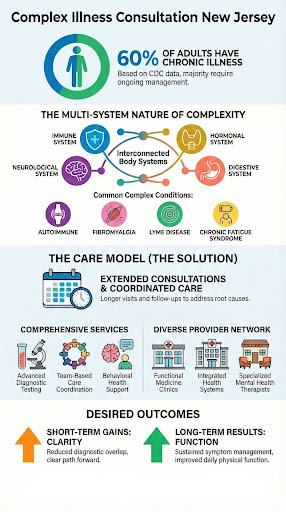
You can usually feel early on if a practitioner is a good fit, but it helps to test that feeling with a few clear checks instead of guessing. Functional medicine asks a lot from patients, including changes in food, sleep, stress, and habits, so the relationship and communication style matter as much as the protocol, especially when navigating layered symptoms that benefit from a complex illness consultation rather than a single-condition focus.
A short discovery call is a good place to start. You can ask:
- “How do you create and adjust personalized health plans?”
You want to hear how they factor in your history, preferences, and feedback over time. - “Which labs do you tend to use, and why those?”
Look for simple, direct explanations you can repeat back to someone else. - “How do you explain costs, timelines, and realistic expectations?”
Clear, pressure-free answers are a good sign of transparency.
Reviews can add another layer. Focus on comments about:
- Feeling listened to and not rushed
- Clear next steps and follow-up
- Willingness to coordinate with other doctors
Patient-centered care has been linked to better treatment follow-through, and you can usually see traces of that in how they talk, plan, and document their process. Patients in southern New Jersey can experience this patient-centered approach with a complex illness consultation who prioritizes communication and personalized care.
What red flags should we avoid when choosing a practitioner?
Credits: Dr. Steven Noseworthy
Most people focus on what to look for in a practitioner, but knowing what to avoid is just as important, especially when your time, health, and money are all on the line. Ethical functional medicine is grounded in licensure, evidence, and clear explanations. When those pieces are missing or feel “foggy,” that’s your signal to step back.
Key red flags include:
- Unclear or unverified credentials
- No visible license (MD, DO, NP, ND in licensed regions)
- No way to confirm their registration on official boards
- Vague training claims without specific programs or institutions
- Sales pressure and quick-fix promises
- Being pushed into large supplement bundles or programs right away
- Expensive testing with little or no explanation of why it’s needed
- Claims to “cure” complex chronic conditions quickly
- Lack of personalization or collaboration
- Standard plans that look the same for everyone
- Little interest in your story, context, or current medications
- Refusal to communicate with your primary care doctor when needed
A practitioner who is a good fit will answer questions calmly, explain why they recommend each step, and be honest about limits and realistic timelines.
How much does functional medicine cost, and is it covered by insurance?
Money is often one of the hardest parts of starting functional medicine, so it helps to have a simple, realistic picture of costs before you commit. Most care is at least partly out of pocket, and insurance coverage is still limited in many places.
You’ll usually see costs in a few main areas:
- Initial consultation
Often around 300–300–300–600 for a 60–90 minute deep review of your history, symptoms, and goals. - Follow-up visits
Lower than the first visit, especially if shorter or done by telehealth. - Functional lab testing
Pricing varies a lot. Some key panels may be a few hundred dollars, while broader testing can cost more. - Supplements and nutrition support
Monthly costs depend on how many products are used and for how long.
Insurance may cover part of standard labs, but often not advanced testing or long consults. Some clinics provide detailed receipts (superbills) you can submit for possible out-of-network reimbursement.
To manage costs, you can ask your practitioner to:
- Prioritize or phase testing instead of ordering everything at once
- Use telehealth to avoid travel expenses
- Build a plan that fits your budget so care is sustainable over time.
Frequently Asked Questions
How do I choose the right functional medicine practitioner for chronic health concerns?
Choose a functional medicine doctor or holistic practitioner who clearly explains their patient-centered care process. Verify practitioner credentials, board certification, and medical license verification. Ask how they perform root cause analysis, use comprehensive lab testing, and build a personalized health plan. Review patient testimonials and success stories to confirm experience with chronic illness treatment and clear, consistent communication.
If you are looking for personalized care, a functional medicine doctor Union County patients trust can help identify underlying causes of chronic health concerns and develop a tailored treatment strategy focused on long-term wellness.
What testing should an integrative medicine specialist discuss before starting treatment?
An integrative medicine specialist should clearly explain which functional lab panels are needed and why. This includes comprehensive lab testing, biomarker analysis, stool testing, food sensitivity testing, and genomic testing when appropriate. Each test should connect directly to nutritional therapy, lifestyle medicine, and individualized dosing, with transparent timelines, costs, and how results guide clinical decisions.
Why is patient-centered and collaborative care important in functional medicine?
Patient-centered care ensures the holistic practitioner listens, educates, and adjusts treatment based on progress. A collaborative care model may include health coaching integration, stress management techniques, sleep optimization strategies, movement therapy, and mind-body medicine. This structure supports long-term behavior change and accountability. Telehealth functional doctor options can also maintain continuity through virtual consultation and scheduled follow-ups.
What conditions and clinical experience should a functional medicine doctor have?
A functional medicine doctor should demonstrate experience treating complex conditions using a systems biology approach. This includes gut health expertise, microbiome restoration, SIBO treatment, leaky gut protocol, and anti-inflammatory diet planning. They should also manage autoimmune protocol cases, hormone balancing, adrenal fatigue support, thyroid optimization, and post-viral syndrome or long COVID recovery using evidence-based methods.
What questions help identify red flags during a discovery call?
During a discovery call, ask about treatment philosophy, follow-up structure, and decision-making processes. Red flags include one-size-fits-all plans, unclear root cause analysis, and limited comprehensive lab testing. Confirm how supplement protocols, detoxification protocols, environmental toxin assessment, and lifestyle medicine are monitored. Reliable practitioners explain goals, timelines, risks, and expected outcomes in measurable, practical terms.
Finding the Right Functional Medicine Practitioner for Long-Term Care
Finding the right functional medicine practitioner for long-term care starts with being intentional: checking licenses, looking at training, and noticing how a clinician listens and explains their reasoning. If you’re ready to explore a personalized, root-cause approach, consult a Functional Medicine Doctor Monmouth County at Advanced Integrated Health and start mapping out your long-term strategy.

Dr. Bob was born and raised in Florham Park, New Jersey.
He loved the philosophy of vitalism, which teaches about the incredible, innate intelligence of our bodies and its power to self-heal when given the opportunity.