
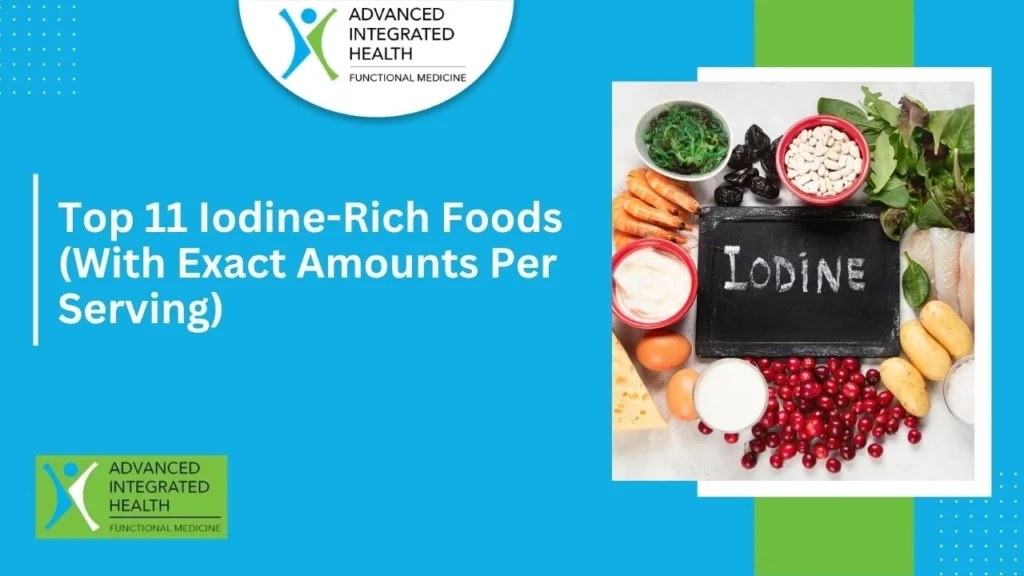
About one in three people worldwide doesn’t get enough iodine, according to the World Health Organization. For more on thyroid health signs linked to iodine, visit our detailed guide to unhealthy thyroid tongue symptoms and what they mean. That’s a problem because your thyroid runs on it. Without enough, the gland that controls your metabolism, body temperature, and hormone balance starts to slow down or struggle to keep up. The good news is that adding more iodine rich foods to your meals doesn’t require fancy supplements or strange superfoods. Most of the best sources sit in your fridge or grocery aisle right now. The trick is knowing which iodine rich foods actually deliver and how much you’re really getting per serving. Below you’ll find the 11 highest-iodine foods ranked by exact micrograms per serving, with the NIH Office of Dietary Supplements numbers as the source of truth. Every food gets a quick-facts block so you can scan, screenshot, or save what matters.
Quick Summary
- The adult RDA is 150 mcg of iodine per day. Pregnant women need 220 mcg, and lactating women need 290 mcg.
- Enriched bread made with iodate dough conditioners is the unexpected leader on this list (around 198 mcg in 2 slices).
- Baked cod, Greek yogurt, oysters, and nonfat milk all land between 85 and 158 mcg per serving.
- Iodized salt is still the easiest fix. Just 1/4 teaspoon gives you 76 mcg, about half your daily value.
- If you skip dairy, seafood, and iodized salt, you’re at higher risk and may want a urine iodine test or a quick consult with a functional medicine provider.
Why your body needs iodine
Iodine is a trace mineral your thyroid uses to produce two hormones: thyroxine (T4) and triiodothyronine (T3). These hormones run nearly everything that keeps you alive, including heart rate, metabolism, body temperature, brain development in children, and the regulation of growth and energy. The current adult Recommended Dietary Allowance is 150 mcg per day, with higher needs during pregnancy (220 mcg) and breastfeeding (290 mcg), per the National Academies’ dietary reference intake guidelines.
Common signs that you might be running low include fatigue, neck swelling, dry skin, hair thinning, sensitivity to cold, and unexplained weight gain. Women may also notice heavier or irregular periods. These symptoms overlap with other thyroid issues, so don’t self-diagnose. For a deeper understanding, visit our detailed guide on iodine and thyroid health. If you want to learn how diet supports thyroid function, check out our post on the importance of a healthy diet for thyroid function. A simple urine iodine test or TSH panel will tell you what your numbers actually look like.
Quick comparison: the 11 foods ranked by iodine content
| # | Food | Serving | Iodine (mcg) | % DV |
|---|---|---|---|---|
| 1 | Enriched bread (with iodate conditioners) | 2 slices | 198 | 132% |
| 2 | Cod, baked | 3 oz | 158 | 105% |
| 3 | Greek yogurt, plain low-fat | 1 cup | 116 | 77% |
| 4 | Oysters, cooked | 3 oz | 93 | 62% |
| 5 | Milk, nonfat | 1 cup | 85 | 57% |
| 6 | Iodized salt | 1/4 tsp | 76 | 51% |
| 7 | Seaweed (nori sheet) | 5 g | 70 | 47% |
| 8 | Egg, hard-boiled | 1 large | 26 | 17% |
| 9 | Cheddar cheese | 1 oz | 14 | 9% |
| 10 | Beef liver, cooked | 3 oz | 14 | 9% |
| 11 | Shrimp, cooked | 3 oz | 13 | 9% |
Daily Value calculated against the 150 mcg adult RDA. Source: NIH Office of Dietary Supplements.
The Most 11 Iodine Rich Foods
1. Enriched bread (198 mcg per 2 slices)
Bread sneaks onto this list because of dough conditioners. Commercial bakeries use calcium iodate and potassium iodate to improve dough texture, and that pushes iodine levels up significantly in the final loaf. A 2004 Boston University analysis found two slices of enriched bread can deliver more iodine than a serving of fish. Not every loaf qualifies. Artisan and sourdough breads usually skip the iodate conditioners. If you want to know whether yours counts, check the ingredient list for “calcium iodate” or “potassium iodate.”
Quick facts:
- Iodine: 198 mcg per 2 slices (varies by brand)
- Daily Value: 132%
- Best fit: Sandwich loaves and sliced commercial breads
- Skip: Artisan, sourdough, organic small-batch (rarely use iodate conditioners)
- How to confirm: Look for “calcium iodate” or “potassium iodate” on the label
2. Cod (158 mcg per 3 oz baked)
Cod absorbs iodine from seawater and stores more of it than most other fish. A standard 3-ounce baked filet covers about 105% of your daily need on its own. Its mild taste and flaky texture also make it forgiving in the kitchen, which is part of why it shows up so often on weeknight dinner tables.
Quick facts:
- Iodine: 158 mcg per 3 oz baked
- Daily Value: 105%
- Best prep: Baked, steamed, or broiled (gentler heat preserves more iodine)
- Two servings a week: covers the adult RDA on its own
- Skip: Deep-fried fish (high heat plus oil reduces what you absorb)
3. Greek yogurt (116 mcg per cup, plain low-fat)
Dairy is a sneaky-good iodine source. Cows are often fed iodine-supplemented feed, and the dairy industry uses iodine-based sanitizers on milking equipment that can transfer trace amounts into milk. Greek yogurt, because it’s strained and concentrated, ends up with more iodine per gram than regular yogurt. One cup of plain low-fat Greek yogurt delivers 116 mcg, or about 77% of your daily value.
Quick facts:
- Iodine: 116 mcg per cup (plain, low-fat)
- Daily Value: 77%
- Better than: Regular yogurt (about half the iodine per cup)
- Watch out: Flavored varieties have less yogurt per cup, more sugar, lower iodine
- Pair with: Berries and chopped nuts for a complete breakfast
4. Oysters (93 mcg per 3 oz cooked)
Oysters are filter feeders, meaning they pull seawater across their gills constantly. That process traps iodine in their tissues. Three ounces of cooked oysters give you 62% of your daily value, plus zinc and B12 that most diets are short on.
Quick facts:
- Iodine: 93 mcg per 3 oz cooked
- Daily Value: 62%
- Bonus nutrients: Zinc, vitamin B12, copper
- Best prep: Steamed, grilled, or in a stew
- Watch out: Raw oysters carry foodborne illness risk for pregnant women, immunocompromised people, and older adults
5. Milk, nonfat (85 mcg per cup)
Cow’s milk in the U.S. averages around 85 mcg of iodine per cup, with significant variation by region and brand. The 2004 Boston University study found ranges from 47 to 162 mcg per cup. Whole, low-fat, and nonfat milk are similar on iodine. Fat content doesn’t move the number much.
Quick facts:
- Iodine: 85 mcg per cup (nonfat)
- Daily Value: 57%
- Whole vs nonfat: Iodine content is similar across fat levels
- Brand variation: Regional brands swing from 47 to 162 mcg per cup
- Plant milks: Almond, oat, and soy are not naturally high; check labels for fortification
6. Iodized salt (76 mcg per 1/4 teaspoon)
Iodized salt is the public health win of the 20th century. Before it became standard in the 1920s, goiter rates in the Great Lakes region (the so-called “goiter belt”) ran above 30%. The FDA permits up to 100 mcg of iodine per gram of salt; most commercial brands hit around 76 mcg per quarter teaspoon. Sea salt, kosher salt, and Himalayan pink salt are not iodized unless explicitly labeled.
Quick facts:
- Iodine: 76 mcg per 1/4 teaspoon
- Daily Value: 51%
- Easy fix: Swap your everyday cooking salt for iodized
- Skip the assumption: Sea salt, kosher salt, Himalayan pink are not iodized unless the label says so
- Storage: Iodine evaporates over time; replace your salt every 12 to 18 months
7. Seaweed, especially nori (around 70 mcg per 5 g sheet)
Seaweed pulls minerals straight from the ocean, which makes it one of the most iodine-dense foods on the planet. Nori sheets, the kind used for sushi, deliver around 70 mcg in just 5 grams. Kombu and kelp are even higher and can swing into excessive territory if eaten regularly. Stick with nori or wakame for everyday use, and treat kombu like a stock ingredient, not a snack.
Quick facts:
- Iodine: 16 to 2,984 mcg per gram (varies dramatically by type)
- Daily Value: About 47% from one nori sheet (5 g)
- Best for everyday: Nori sheets and wakame (lower, more predictable levels)
- Watch out: Kombu and kelp can deliver 4,000+ mcg per serving, which is easy to over-consume
- Best prep: Roasted nori, miso soup, sushi rolls, salad toppers
8. Eggs (26 mcg per large hard-boiled)
The yolk is where the iodine lives. If you eat only egg whites, you’re skipping most of it. One hard-boiled egg covers 17% of your daily target. Hard-boiling preserves more iodine than scrambling or frying because the yolk stays intact and doesn’t oxidize as much.
Quick facts:
- Iodine: 26 mcg per large hard-boiled egg
- Daily Value: 17%
- Yolk vs white: Almost all the iodine is in the yolk
- Best prep: Hard-boiled or poached (gentler on the yolk)
- Stack with: A glass of milk and a slice of toast for around 110 mcg in one breakfast
9. Cheddar cheese (14 mcg per oz)
Cheese inherits iodine from its source milk. Cheddar offers about 14 mcg per ounce, which alone won’t move the needle, but stacks well with other dairy across a day. Aged cheeses can vary because of moisture loss during aging.
Quick facts:
- Iodine: 14 mcg per oz
- Daily Value: 9%
- Stack strategy: Pair with milk, yogurt, or eggs to compound iodine across the day
- Aged vs young: Younger cheeses tend to test slightly higher (less moisture loss)
- Note: Imported cheeses can vary a lot depending on the dairy practices in the source country
10. Beef liver (14 mcg per 3 oz cooked)
Liver isn’t for everyone. If you eat it, you’ll get 14 mcg of iodine per 3-ounce cooked serving, plus a heavy load of vitamin A, B12, and copper. Pasture-raised beef has more variable iodine because the cattle’s diet shifts more with the season.
Quick facts:
- Iodine: 14 mcg per 3 oz cooked
- Daily Value: 9%
- Bonus nutrients: Very high in vitamin A, B12, iron, and copper
- Watch out: Pregnant women should limit liver to once a week (vitamin A toxicity risk)
- Best prep: Pâté, liver and onions, or blended into ground beef for a milder flavor
11. Shrimp (13 mcg per 3 oz cooked)
Shrimp is lower than other seafood because they live in coastal waters with less mineral density and don’t store iodine as efficiently as larger fish. Three ounces still gets you 9% of your daily value, plus high-quality protein and selenium that supports thyroid function alongside iodine.
Quick facts:
- Iodine: 13 mcg per 3 oz cooked
- Daily Value: 9%
- Bonus nutrient: Selenium (works with iodine to support thyroid function)
- Best prep: Steamed, sautéed, or grilled
- Skip: Heavily breaded or fried shrimp; most of what you’re eating becomes oil and flour
Who’s most at risk for iodine deficiency?
Even in countries with iodized salt programs, certain groups still come up short. You may want to pay closer attention if you:
- Avoid iodized salt in favor of sea salt, kosher salt, or Himalayan pink
- Are pregnant, breastfeeding, or trying to conceive
- Follow a vegan or strict plant-based diet (most iodine-dense foods are animal-based)
- Live in a region with iodine-poor soil
- Take certain medications, including amiodarone or lithium
- Have an autoimmune thyroid condition
The 2017 American Thyroid Association guidelines for thyroid disease in pregnancy note that mild iodine deficiency has been resurging in the U.S., especially among women of reproductive age. If you suspect you’re low, a urine iodine test or a TSH panel will give you a clearer picture than guessing.
Can you have too much iodine?
Yes, although it’s harder to overdo than to fall short. The tolerable upper intake level for adults is 1,100 mcg per day. Most people in iodine-replete countries don’t hit that through diet alone, but high-dose kelp supplements, large quantities of seaweed, or stacking multiple fortified products can push some people over.
People with autoimmune thyroid disease (such as Hashimoto’s or Graves’) are more sensitive and can develop iodine-induced hyperthyroidism or worsen existing thyroid dysfunction with even small excesses. If you have a known thyroid condition, talk to a provider before adding kelp supplements or eating large amounts of seaweed.
Frequently asked questions
What’s the fastest way to fix iodine deficiency through food?
Adding iodized salt to your cooking and eating one serving of seafood (cod, oysters, shrimp) two or three times a week typically gets most people to the 150 mcg target within a few days.
Does Himalayan pink salt have iodine?
No. Himalayan pink salt contains trace minerals from its source rock, but iodine isn’t one of them in any meaningful amount. If you only use pink salt, you’re missing the easiest dietary source.
Can I get enough iodine on a vegan diet?
It’s possible, but harder. Seaweed and iodized salt become your main reliable sources. Some plant-based milks are fortified, most are not. Many vegan dietitians recommend a low-dose iodine supplement.
How long does it take to correct iodine deficiency?
Mild deficiency usually resolves in 2 to 4 weeks of consistent intake at or above the RDA. Severe deficiency or cases involving thyroid damage can take months and often need medical supervision.
Are iodine supplements safe?
Low-dose iodine supplements (around 150 mcg) are safe for most adults. High-dose kelp or iodine pills above 500 mcg per day can trigger thyroid problems in sensitive people. Run any supplement past your provider before starting.
Final Thoughts
If you eat dairy, seafood, or iodized salt with any regularity, you’re probably fine. If you don’t, your thyroid will let you know eventually. Listing 11 foods is one thing. Knowing whether your body is actually getting what it needs is another. If you’re seeing signs that something is off (persistent fatigue, weight changes, brain fog, irregular cycles), the team at Advanced Integrated Health can run functional lab work to check your thyroid and iodine status before recommending changes.
Sources
National Institutes of Health, Office of Dietary Supplements. Iodine Fact Sheet for Health Professionals.
https://ods.od.nih.gov/factsheets/Iodine-HealthProfessional/
Natinal Institutes of Health, Office of Dietary Supplements. Iodine Fact Sheet for Consumers.
https://ods.od.nih.gov/factsheets/Iodine-Consumer/
World Health Organization. Iodine deficiency disorders and global iodine status. WHO Nutrition Landscape Information System (NLiS).
https://www.who.int/data/nutrition/nlis/info/iodine-deficiency
Institute of Medicine. Dietary Reference Intakes for Vitamin A, Vitamin K, Arsenic, Boron, Chromium, Copper, Iodine, Iron, Manganese, Molybdenum, Nickel, Silicon, Vanadium, and Zinc. National Academies Press, 2001.
https://nap.nationalacademies.org/catalog/10026
Pearce EN, Pino S, He X, Bazrafshan HR, Lee SL, Braverman LE. Sources of dietary iodine: bread, cows’ milk, and infant formula in the Boston area. J Clin Endocrinol Metab. 2004;89(7):3421-3424.
https://pubmed.ncbi.nlm.nih.gov/15240625/
Leung AM, Pearce EN, Braverman LE. Role of iodine in thyroid physiology. Expert Review of Endocrinology & Metabolism. 2010;5(4):593-602.
https://doi.org/10.1586/eem.10.40
American Thyroid Association. Statement on the Potential Risks of Excess Iodine Ingestion and Exposure.
Alexander EK, Pearce EN, Brent GA, et al. 2017 Guidelines of the American Thyroid Association for the Diagnosis and Management of Thyroid Disease During Pregnancy and the Postpartum. Thyroid. 2017;27(3):315-389.
https://www.liebertpub.com/doi/full/10.1089/thy.2016.0457

Dr. Bob was born and raised in Florham Park, New Jersey.
He loved the philosophy of vitalism, which teaches about the incredible, innate intelligence of our bodies and its power to self-heal when given the opportunity.