
Most people looking for an autoimmune disease specialist in Union County will see a rheumatologist, a doctor trained to find and treat immune problems that affect joints, muscles, and organs. These specialists use exams, blood tests, imaging, and careful follow-up to confirm what’s going on, then build long-term treatment plans that fit daily life.
In Union County and across New Jersey, they care for both common and rare autoimmune conditions, often working with other doctors when needed. If you’re unsure where to start or who to see, keep reading to understand your options and plan your next step with more confidence.
Key Takeaways
- Rheumatologists are the primary autoimmune disease specialists serving Union County and nearby New Jersey areas.
- Most care includes structured diagnosis, medication management, and coordination with other health services.
- Preparing for appointments and choosing specialists carefully support better long-term disease control.
What type of doctor treats autoimmune diseases in Union County?
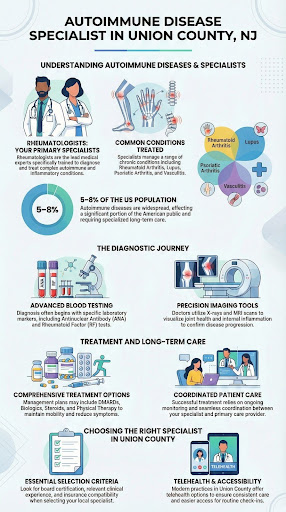
Most autoimmune diseases in Union County are treated by rheumatologists. These doctors are trained in internal medicine first, then receive extra education in immune-related disorders that affect joints, connective tissue, and organs. Autoimmune diseases affect about 5–8% of people in the United States, according to the American College of Rheumatology, so this care is not rare or fringe.
In Union County, rheumatologists usually act as the main doctors for long-term autoimmune care. They confirm diagnoses, guide medication plans, and follow disease activity over time, often through large systems like RWJBarnabas Health that support testing and follow-up.
Common conditions treated by local rheumatologists include:
- Rheumatoid arthritis
- Lupus
- Psoriatic arthritis
- Sjögren’s syndrome
- Vasculitis
- Scleroderma
Rheumatoid arthritis alone affects around 1.3 million people in the United States, based on data from the American College of Rheumatology. Because many autoimmune diseases are long-lasting, care is usually ongoing and structured.
Rheumatologists focus on both symptom relief and long-term disease control, using evidence-based treatments and regular check-ins instead of one-time or quick fixes.
Which autoimmune diseases are most commonly treated in Union County?

Most autoimmune diseases treated in Union County fall into a few main groups, and they often show up first as joint pain, stiffness, swelling, or ongoing fatigue. Many patients come in not knowing they have an autoimmune condition, only that something “feels off” and is not going away with basic care.
Common categories seen in local rheumatology practices include:
- Inflammatory arthritis
- Rheumatoid arthritis
- Psoriatic arthritis
- Systemic autoimmune diseases
- Lupus
- Vasculitis
- Metabolic and inflammatory overlap
- Gout
Lupus, for example, is diagnosed more often in women than men, roughly 2–3 times more frequently based on state and national data, and rheumatologists in Union County report similar patterns in their patients. Seeing how these conditions are grouped helps explain how specialists plan care. It shapes which tests they order, how often they schedule follow-ups, and what kind of long-term treatment they recommend.
For patients, knowing these common disease types can make it easier to ask focused questions and understand what kind of expertise is available close to home.
How do autoimmune disease specialists diagnose conditions?
Autoimmune disease specialists in Union County diagnose conditions by looking at the whole picture, not just one lab result, an approach that aligns with functional medicine care and integrative foundations that examine how symptoms, labs, and daily patterns interact. They listen to your symptoms, review your history, examine your joints and muscles, then match what they see with blood tests and imaging results over time.
Blood work is a key part of this process. For example, RWJBarnabas Health notes that ANA tests are positive in more than 95% of lupus cases, but a positive ANA alone does not prove lupus. Doctors compare these numbers with symptoms like fatigue, rashes, or joint pain to see what truly fits. Imaging, such as X-ray, ultrasound, or MRI, helps show inflammation and early joint or tissue changes, sometimes before permanent damage appears. Physical exams remain important at every visit to check swelling, strength, and movement.
Diagnosis usually takes several appointments. This pace allows the specialist to rule out look-alike conditions and choose safer, more accurate treatments.
Common diagnostic tools used
- Blood tests such as ANA, RF, anti-CCP, ESR, and CRP
- Imaging, including X-ray, MRI, and musculoskeletal ultrasound
- Detailed symptom timelines and family medical history
What treatments do autoimmune specialists offer locally?

Treatment for autoimmune diseases in Union County usually focuses on lowering inflammation, protecting joints and organs from damage, and supporting daily function, combining rheumatology care with functional medicine services that emphasize personalized healing strategies alongside medical management.
Rheumatologists build plans that often combine medicine, monitoring, and supportive care instead of relying on just one approach. Many patients start on DMARDs (disease-modifying antirheumatic drugs). Studies show these medicines can slow rheumatoid arthritis progression by about 50–60%, with methotrexate often used as a first choice. If disease activity stays moderate to high, doctors may add biologic drugs, such as TNF inhibitors, for stronger control.
Short courses of steroids like prednisone may be used to calm flares, but specialists try to avoid long-term steroid use because of side effects. Supportive care, including physical therapy, helps protect mobility, strength, and joint function.
Care models across New Jersey emphasize steady follow-up and coordination with primary care and other specialists, so treatment stays safe and consistent over time.
Core treatment options
- DMARDs (e.g., methotrexate, sulfasalazine) – long-term disease control
- Biologics (e.g., TNF inhibitors) – moderate to severe disease
- Steroids (e.g., prednisone) – short-term flare control
- Supportive care (e.g., physical therapy) – mobility and strength support
| Therapy type | Examples | Use case |
| DMARDs | Methotrexate, sulfasalazine | Long-term disease control |
| Biologics | TNF inhibitors | Moderate to severe disease |
| Steroids | Prednisone | Short-term flare control |
| Supportive care | Physical therapy | Mobility and strength support |
Which autoimmune specialists practice in or near Union County?
Many people in Union County receive autoimmune care from board-certified rheumatologists based in both hospital-affiliated and private practices. These doctors often work within larger systems, such as RWJBarnabas Health, which helps connect patients to on-site labs, imaging, and infusion centers when needed.
Patients commonly travel within the county for care, including to nearby towns like Summit, which adds more options while still keeping visits fairly local, and some individuals also explore supportive care with a functional medicine doctor in Springfield, NJ, to address lifestyle and whole-body factors alongside specialist treatment.
Since access can depend on insurance plans and each doctor’s subspecialty, it’s wise to confirm coverage and availability before scheduling, as openings can shift during the year.
Noted rheumatologists serving the area
- Dr. Runsheng Wang – Garden State Rheumatology Consultants, Union, NJ
- Dr. Tariq Mahmood – Rheumatology and Immunology, Union, NJ
- Dr. David Worth – Rheumatology, Union, NJ
- Summit area: Dr. Nicole Daver and Dr. Eric Dein
Public directories such as MediFind and hospital websites list these specialists and offer updated information on locations, hours, and whether they are taking new patients.
How do we choose the right autoimmune disease specialist?
Choosing the right autoimmune disease specialist is really about fit, medical fit, practical fit, and long-term support. Most patients balance three main factors: the doctor’s expertise, insurance coverage, and how easy it is to get care when it’s actually needed.
Surveys from platforms like Zocdoc show that more than 80% of patients place insurance acceptance at the top of their list, which makes sense when you think about ongoing visits, lab work, and medications.
Experience with your specific condition also matters, since someone who regularly treats lupus, rheumatoid arthritis, or vasculitis is more likely to recognize subtle changes early. Board certification in rheumatology is another key marker, since it reflects focused training and continuing education.
Communication style and follow-up access, such as patient portals or telehealth, shape what day-to-day care feels like, especially for a long-term illness.
Selection checklist
- Board certification in Rheumatology
- Experience with your specific autoimmune condition
- Access to a hospital, imaging, and infusion services if needed
- Telehealth or flexible options for follow-up visits
Using this kind of checklist helps build steady, coordinated care rather than one-time visits.
Frequently Asked Questions
What does an autoimmune disease specialist in Union County treat?
An autoimmune disease specialist in Union County treats conditions caused by immune system dysfunction that affect joints, muscles, and organs. Patients often see a rheumatologist whom Union County residents rely on for rheumatoid arthritis, lupus, scleroderma, vasculitis, and inflammatory arthritis. Care includes accurate diagnosis, medication management, flare prevention, and long-term monitoring based on autoimmune disease treatment in New Jersey standards.
Which conditions are managed by an autoimmune specialist in NJ near Union County?
An autoimmune specialist in NJ manages a wide range of conditions, including psoriatic arthritis, ankylosing spondylitis, gout, fibromyalgia, and osteoporosis. Many also treat Sjogren’s syndrome, Raynaud’s disease, polymyalgia rheumatica, bursitis, sarcoidosis, and Lyme disease arthritis. This comprehensive care helps patients in Union County address chronic joint pain and systemic autoimmune symptoms effectively.
How can I choose the best rheumatologist in Union, NJ, for my condition?
To choose the best rheumatologist Union NJ offers, patients should confirm board certification and clinical experience. Look for a rheumatology clinic that Union County residents can easily access, one that is accepting new patients for autoimmune doctor appointments. Ask about experience with DMARDs specialists, Union care, biologic infusions, rheumatologist services, and steroid therapy, autoimmune NJ protocols for long-term disease control.
What is the usual approach to autoimmune disease treatment that New Jersey patients receive?
Autoimmune disease treatment New Jersey patients receive is individualized and evidence-based. Treatment plans often include medication, pain management, arthritis doctor support, and referrals for physical therapy, rheumatology, and Union services. Physicians monitor disease activity and organ involvement, and autoimmune specialist risks through regular evaluations. Multidisciplinary rheumatology care helps coordinate imaging, laboratory testing, and supportive therapies for better outcomes.
Are telehealth rheumatologist visits available for ongoing care?
Many patients can access a telehealth rheumatologist in Union, NJ, for follow-up care. Virtual visits are useful for medication reviews, symptom discussions, and treatment adjustments. In-person visits remain necessary for physical examinations and procedures. Patients should ask clinics about telehealth availability, insurance coverage, and coordination with immunology allergy specialist Union providers when managing complex autoimmune conditions.
Autoimmune Disease Specialist in Union County: Moving Forward With Care
Autoimmune disease specialists in Union County guide patients through diagnosis, treatment, and long-term monitoring using structured medical care and coordinated services. Rheumatologists serve as the central providers for conditions that affect joints, connective tissue, and internal organs, working to control inflammation and protect daily function over time.
If you’re ready for a more organized next step, you can schedule a personalized health strategy session with Advanced Integrated Health. Their team centers care on functional medicine, integrative healthcare, and holistic wellness, helping you map out clear goals, testing needs, and coordination alongside your existing medical specialists.
References

Dr. Bob was born and raised in Florham Park, New Jersey.
He loved the philosophy of vitalism, which teaches about the incredible, innate intelligence of our bodies and its power to self-heal when given the opportunity.