
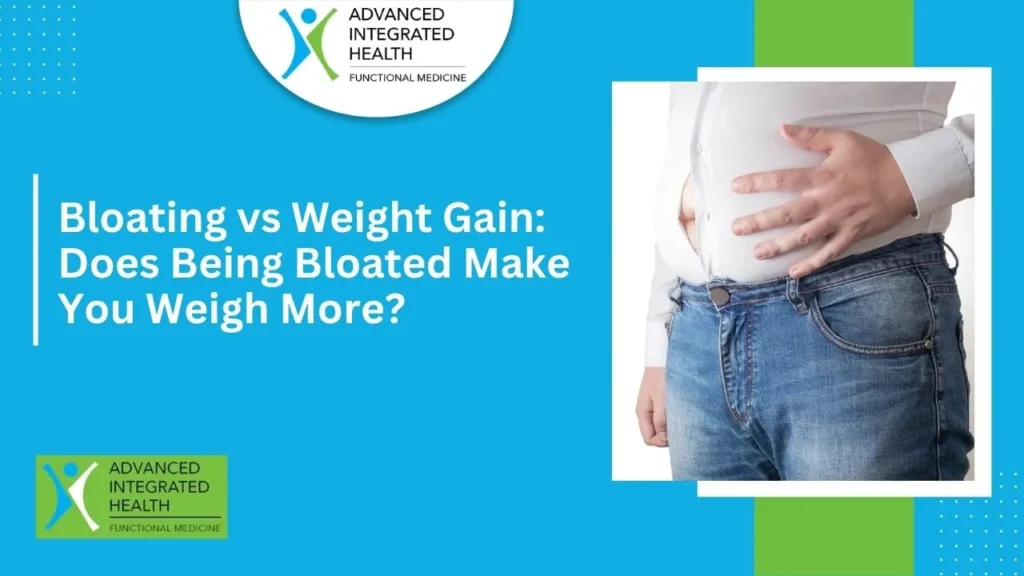
Yes, bloating makes the scale jump. So does being bloated make you weigh more? Absolutely, but only in the short term. Most people see a swing of 1 to 5 pounds when they’re bloated, and it usually clears in 12 to 72 hours. The weight is real in that moment, but it’s not fat. It’s gas, water, and food sitting in your gut. Once your body processes it, the number drops back down. The reason this question matters is that millions of people see a heavier number after a holiday meal or a salty restaurant dinner and assume they gained fat overnight. Fat doesn’t work that way. Gas in the digestive tract and short-term water retention do. Below is the actual math behind does being bloated make you weigh more, how to tell bloating from real weight gain, and when persistent bloating means something more serious.
Quick Summary
- Bloating can add 1 to 5 lbs to the scale, almost always temporarily.
- It comes from three sources: gas in your gut, water retention, and food still in transit.
- Most bloating clears within 12 to 72 hours of the trigger (a meal, a salty day, or hormonal shifts).
- Real fat gain shows up over weeks, not overnight, and shows up across the body, not just the belly.
- Persistent bloating beyond 2 to 3 weeks, or bloating with weight loss, blood, or severe pain, needs a medical evaluation.
Bloating vs. real weight gain at a glance
If your scale is swinging 1 to 5 lbs day to day, the variable is almost always fluid and gut contents, not fat. Use the table to confirm:
| Signal | Bloating | Real weight gain |
|---|---|---|
| Onset | Hours after a meal or salt spike | Weeks to months of calorie surplus |
| Daily scale swing | 1 to 5 lbs, changes by morning | Steady upward trend over weeks |
| Where it shows | Belly distension, tight pants by evening | Across body: thighs, arms, midsection |
| How it feels | Pressure, tightness, gas, urge to burp | Body composition feels heavier overall |
| Resolves with | Hours of sleep, walking, low-sodium meal | Calorie deficit and time |
| Time to fade | 12 to 72 hours | Weeks of consistent effort |

What bloating actually is
Bloating is the feeling of pressure, fullness, or visible distension in your belly. Three things drive it:
- Gas. Your gut produces and traps gas constantly. The average person passes gas up to 25 times a day.
- Water retention. Your body holds onto extra fluid in response to sodium, hormones, or carb load.
- Food in transit. A heavy meal sits in your stomach and small intestine for hours before it moves through.
When two or three of these stack on the same day, the scale and your waistband both react.
The Math: Does Being Bloated Make You Weigh More on the Scale
Here are the numbers that explain a 1 to 5 lb morning weigh-in spike.
- Food and drink in transit: 1 to 3 lbs at any given moment. After a large dinner or buffet, this can briefly hit 4 to 5 lbs before digestion catches up.
- Sodium-driven water: Eating a salty meal pulls extra water into your bloodstream and tissues to keep your sodium concentration steady. This commonly shows up as 1 to 3 lbs on the scale the next morning. Your kidneys excrete the excess over 24 to 48 hours.
- Premenstrual fluid retention: In a year-long study of 62 women, fluid retention scores peaked on the first day of menstrual flow and rose gradually for about 11 days around ovulation. Many women carry 1 to 3 extra lbs in this window.
- Carb load: Each gram of stored glycogen pulls roughly 3 grams of water with it. A high-carb day can bind 1 to 2 extra lbs of water that disappears with a couple of low-carb days.
- Gas: The volume in your gut is significant (you feel it), but the actual weight of gas itself is close to zero. The number it adds to the scale is mostly the food and water it’s mixed with.
Bloating vs. fat gain: how to tell the difference
If you’re trying to figure out which one you’re dealing with, look at five signals.
Quick facts:
- Timing: Bloating shows up in hours; fat gain shows up over weeks.
- Location: Bloating concentrates in the belly; fat gain spreads across the body.
- Daily fluctuation: Bloating swings 1 to 5 lbs day to day; fat gain trends in one direction over time.
- Clothing fit: Bloating tightens your waistband by evening, loose by morning; fat gain stays tight.
- What relieves it: Bloating fades with sleep, walking, or a low-sodium meal; fat gain only fades with a calorie deficit and time.
What causes bloating
Five categories cause most everyday bloating.
1. Fermentable carbs (FODMAPs)
Beans, onions, garlic, wheat, apples, dairy, and certain sweeteners contain carbohydrates your small intestine can’t fully absorb. They pass to your large intestine where bacteria ferment them and produce gas. Many people with IBS-style symptoms find relief on a low-FODMAP plan.
2. High-sodium meals
Restaurant food, processed snacks, deli meats, soy sauce, and canned soup are sodium bombs. Your body holds extra water to balance the sodium, and the scale climbs the next morning. The fix is a normal day of eating, not a juice cleanse.
3. Hormonal cycles
Estrogen and progesterone fluctuations alter how your body handles sodium and water. The week before a period is the classic bloating window. Some women also bloat around ovulation.
4. Swallowed air
Eating fast, drinking through straws, chewing gum, and carbonated drinks all push extra air into your gut. Most of it gets belched, but some travels down and adds to the gas already in transit.
5. Slow digestion or a functional GI condition
Constipation, irritable bowel syndrome, small intestinal bacterial overgrowth (SIBO), and lactose intolerance all cause chronic bloating. If you bloat almost every day regardless of what you eat, this is the bucket to investigate.
How to deflate bloating fast
If you want the number on the scale and the pressure in your belly to go down, these are the moves that actually work.
Quick facts:
- Walk: A 10 to 20-minute walk after a meal moves trapped gas and speeds gastric emptying.
- Cut sodium for a day: Skip restaurant food, soy sauce, and processed snacks. Drink water normally.
- Try peppermint or ginger: A clinical meta-analysis found peppermint oil capsules outperformed placebo for IBS-related bloating and pain (mild heartburn was the most common side effect).
- Sleep: Most water retention clears overnight as your kidneys catch up.
- Skip carbonation and gum: Both add air to your gut without you noticing.
- Don’t starve: Skipping meals slows digestion and worsens bloating. Eat normally and let your body process.
Time is the underrated fix. Most bloating resolves in 12 to 72 hours without doing anything dramatic. If you’re curious about the strongest evidence base for one specific intervention, the data on peppermint oil for IBS symptoms is the most cited.
When bloating is a red flag
Most bloating is benign. But certain patterns deserve a workup. See a provider if you have:
- Bloating that lasts longer than 2 to 3 weeks without an obvious cause
- Unintentional weight loss
- Blood in your stool, or black or tarry stools
- Severe or worsening abdominal pain
- Early satiety (feeling full after a few bites)
- Persistent vomiting
- A family history of GI cancers, especially colon, ovarian, or pancreatic
Persistent bloating in women, particularly after age 50, can be an early symptom of ovarian conditions and warrants evaluation. The Cleveland Clinic overview of bloated stomach has a useful symptom checklist if you want to compare.
Frequently asked questions
How long does bloating last?
Most everyday bloating clears in 12 to 72 hours. Sodium-driven retention resolves overnight. Hormonal bloating tracks with the menstrual cycle. Bloating that persists for weeks is not normal and should be evaluated.
Can you weigh 5 pounds heavier from bloat?
Yes. The combination of food in transit, water retention from sodium or hormones, and a heavy carb load can briefly add up to 5 lbs. It’s not fat. It’s mass that will move through or out of you in a couple of days.
Does drinking water reduce bloating?
Counterintuitively, yes. Mild dehydration triggers your body to hold onto more sodium and water. Steady hydration helps your kidneys flush the excess. Just don’t drink huge volumes during meals (it dilutes digestion and adds gas).
Why am I bloated every day?
Daily bloating usually points to a structural cause: IBS, SIBO, lactose or fructose malabsorption, chronic constipation, or food sensitivities. A Mayo Clinic symptom workup for belching, gas, and bloating is a reasonable place to start before going to a specialist.
Bloating vs. visceral fat: what’s the difference?
Bloating is gas, water, and food expanding your gut temporarily. Visceral fat is actual fat tissue stored around your organs and it doesn’t come and go in 24 hours. If your belly looks bigger by evening and smaller by morning, that’s bloating. If your belly is consistently large regardless of meals, that’s visceral fat (and a different conversation).
Final Thoughts
If your scale jumped 3 lbs after a salty dinner, you didn’t gain fat. You gained water and gut contents that will move through. rack your weight as a 7-day moving average instead of a daily number, and you’ll see the bloat noise smooth out and the real weight loss trend show up. If your bloating is daily, painful, or paired with weight loss, blood, or persistent pain, it’s worth a workup. Functional medicine providers like the team at Advanced Integrated Health can run targeted lab work (IBS panels, SIBO breath tests, food sensitivity, thyroid, hormones) to find the actual driver instead of guessing.
Sources
National Institute of Diabetes and Digestive and Kidney Diseases (NIDDK). Gas in the Digestive Tract.
https://www.niddk.nih.gov/health-information/digestive-diseases/gas-digestive-tract
National Institute of Diabetes and Digestive and Kidney Diseases (NIDDK). Symptoms & Causes of Gas in the Digestive Tract.
https://www.niddk.nih.gov/health-information/digestive-diseases/gas-digestive-tract/symptoms-causes
National Institute of Diabetes and Digestive and Kidney Diseases (NIDDK). Irritable Bowel Syndrome.
https://www.niddk.nih.gov/health-information/digestive-diseases/irritable-bowel-syndrome
National Institute of Diabetes and Digestive and Kidney Diseases (NIDDK). Eating, Diet, and Nutrition for Irritable Bowel Syndrome.
Mayo Clinic. Belching, gas and bloating: Causes.
https://www.mayoclinic.org/symptoms/belching-gas-and-bloating/basics/definition/sym-20050922
Cleveland Clinic. Bloated Stomach: Causes, Symptoms, Diagnosis & Treatment.
https://my.clevelandclinic.org/health/symptoms/21740-bloated-stomach
White CP, Hitchcock CL, Vigna YM, Prior JC. Fluid Retention over the Menstrual Cycle: 1-Year Data from the Prospective Ovulation Cohort. Obstet Gynecol Int. 2011;2011:138451.
https://pubmed.ncbi.nlm.nih.gov/21845193/
Khanna R, MacDonald JK, Levesque BG. Peppermint oil for the treatment of irritable bowel syndrome: a systematic review and meta-analysis. J Clin Gastroenterol. 2014;48(6):505-512.
https://pubmed.ncbi.nlm.nih.gov/24100754/

Dr. Bob was born and raised in Florham Park, New Jersey.
He loved the philosophy of vitalism, which teaches about the incredible, innate intelligence of our bodies and its power to self-heal when given the opportunity.